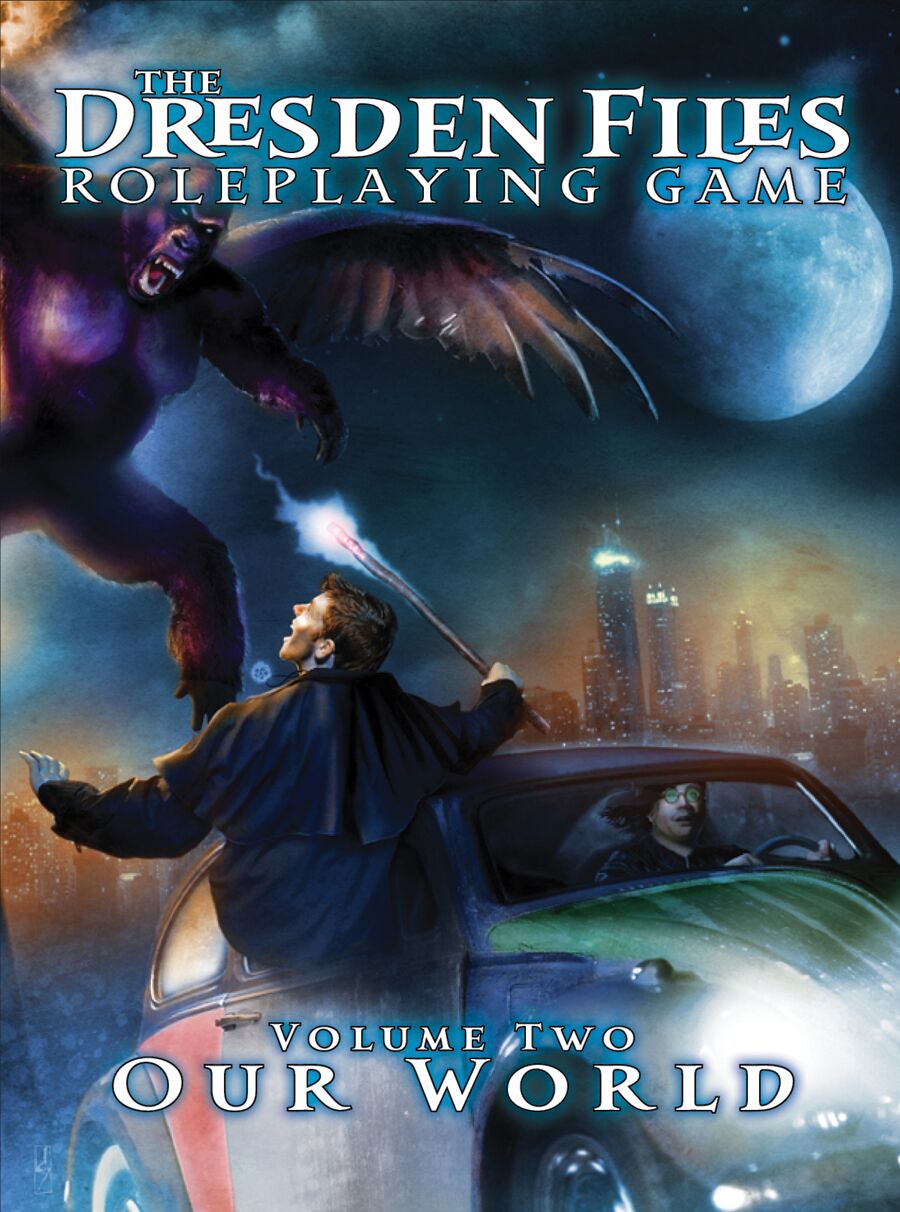
Do You Have What It Takes?

We're ready to hear from you if you think you and your group has what it takes to playtest the Dresden Files RPG. We're still thoroughly within the "alpha" stages, but we want to hear from you so we can chart a trajectory for our playtesting -- and maybe get you in somewhere on the schedule. If you think you fit the bill, fill out our extensive playtesting application!

We Have a Forum

We have a forum over at Jim-Butcher.Com, in addition to our DFRPG-Chat mailing list and updates mailing list. Come and join us, however it suits you!

Recent Headlines

May 05 Fred and Lenny Speak on Latest Podcast
Apr 11 Playtesting! Art! More!
Mar 17 A View of the Road Ahead from Evil Hat
Mar 05 Playtester Rick Neal Is At It Again
Feb 12 Dresden Files Playtest Sightings
Feb 04 Newark's More Exciting (and Dangerous) Than You Might Think...
Feb 01 Art Preview: Burn, You Greasy Bat Faced Bastards, Burn!
Jan 11 Evil Hat Interview and Playtest Update
Nov 25 Update on Playtest Applicants
Oct 09 The Laws of Magic: Part 8 of 8

Contact Us!

We'd love to hear whatever you have to say. Please use our handy contact form to drop us a line!

« Sign Up for the New Updates List | Main | The Laws of Magic: Part 2 of 8 »

The Laws of Magic: Part 1 of 8
June 08, 2007

This starts part one of an eight-part series as we look at the Laws of Magic and how they affect the game in play. There be spoilers here! Much like anything excerpted from the book!

The Laws of Magic

The White Council's Wardens are the main law enforcement body of the supernatural world (at least as far as mortals go)—and for the Wardens, the Laws of Magic are sacrosanct. The Laws of Magic are clear, concise, and offer little in the way of "wiggle room" (at least in the views of some Wardens), but are very much written to communicate the spirit of the law—which is the mode in which they are enforced. This stands in contrast to the other major body of supernatural legalese, the Unseelie Accords, where there is no spirit of the law—only the letter.

Here, we'll discuss what it actually means to break one of the Laws of Magic, looking at each one in depth, finding where the grey areas are in this code that separates black magic from white.

In practice, the Accords and the Laws are polar opposites. The Laws are clearly spelled out, but there are some grey areas where flexible standards of enforcement are seen. The Accords meanwhile are incredibly Byzantine but absolutely iron-clad when enforced—often to a fault.

Breaking the Laws of Magic

"The way magic works, whenever you do something with it, it comes from inside of you. Wizards have to focus on what they're trying to do, visualize it, believe in it, to make it work. You can't make something happen that isn't a part of you, inside."

— Storm Front

While the Laws of Magic may seem more like a guide for living right as a spellcaster, they are there for a very serious, very palpable reason--whenever you make use of true black magic, using your skill at spellcraft in a way that breaks one of the Laws, you change yourself, darkening your soul.

Does white magic change you back once you've gone over the line? Maybe--but we'll talk about that more, later.

It's a very real line that you're stepping over whenever you choose to break one of the Laws of Magic. By taking such an action, you've let the idea into your self-image and your beliefs--the very basis of you as a spellcaster--that you are the sort of person who breaks that Law. And very often, once you do that there's no turning back.

Are you the kind of person who reads thoughts, twists minds, and kills with magic? There are many who believe that once you cross that line, you will be.

Non-People Don't Count... Or Do They?

With the Laws laid down by the White Council it has been made pretty clear that they don't apply to entities that aren't people. The Laws of Magic are strongly oriented on protecting the life and rights of mortals. Creatures and folks that the Council might classify as monsters are fair game.

With that said, this is a rule of thumb where it's easy to stumble into the grey area, with things open to interpretation by the Warden on the scene--and given that Wardens have a lot of latitude as regards the whole "judge, jury, and executioner" bit, it's a grey area that you don't want to step into as a spellcaster, if you can help it.

Consider that when Harry captures Toot-Toot, a faerie, in Storm Front, he has to defend his actions to Warden Morgan. This suggests that the even more than usually hard-assed Morgan was inclined to look at Toot as a person, insofar as violating the Fourth Law goes. Harry made the case that he wasn't enthralling Toot-Toot--the little faerie still could have said "no", since no compulsion was overriding Toot's ability to choose. Luckily, Harry made it past that encounter with Morgan with his head intact.

When a victim is involved (some of the Laws are "victimless"), one standard for judgment is whether or not the victim has a soul. Most of the laws amount to actions which violate the sanctity of life, breaking the bonds that tether a soul to a mortal being, whether by destroying the body or destroying the mind. This is certainly the most palpable or most "valid" way of looking at things; first and foremost, if a soul is involved, the stakes are high, and the Laws are sitting up and paying attention.

But to go beyond that mostly clear-cut standard, there's a fuzzy border dividing people from monsters. Faeries don't have souls, but they might still be seen as people, at least judging by Morgan's reaction to Harry and Toot. In game terms, one way to identify whether or not a creature might count as a person is to look at his or her refresh level. If it's positive--allowing the creature to exercise at least something like free will through the use of fate points--then there's a decent chance this creature might be seen as a person, even without a soul. That said, when dealing with a zero-or-less refresh human, they (arguably) still have a soul--so the Laws still apply, however far gone they might be.

Ultimately this is a decision to be made as suits your own sensibilities for your own game. The best interpretation is the one you feel will work for you instinctively, one that will generate the kinds of stories you're looking to tell.

Enforcement

When it comes to actions taken by the Wardens, the "humans only" part of the Laws is the generally understood application of their breadth, but the Laws themselves aren't worded that way. This is deliberate vagueness in action, which gives the Wardens the "spirit of the law" latitude to investigate would-be warlocks before they go over the edge. In the end, the attitude here is based on the same thinking that recognizes that serial killers often start their careers by torturing animals (which isn't, say, as illegal as doing the same to a person) before moving on up to humans later. In practice, this attitude by the Wardens gets mixed results, including the persecution of folks who aren't actually breaking any Laws or on a short trip to Warlocktown. Still, a Warden has never actually executed someone for that kind of pseudo-breaking of the Laws (that we know of), though Wardens are fond of calling for in-depth investigations on the wizards in question. And such investigations often find out that a Law actually has been broken, once they're able to start poking around.

What Happens When You Break the Laws

In game terms, whenever your character crosses the line for the first time, breaking a Law that he has not broken before, he must immediately take a new lawbreaker stunt. Like any mortal stunt, a lawbreaker stunt reduces your refresh by one--which is where you should sit up and take notice. Remember, if a character's refresh ever drops to zero or below, he stops being a viable player-character. He loses his free will, becoming a creature subservient to his nature, subject to act always in accordance with what he is rather than who he could be. Break enough of the Laws of Magic, and these stunts will eat you alive.

Every lawbreaker stunt offers the same benefits. You gain +1 on your skill rolls when using magic to break that Law again. If you're looking to dye your wool darker, the bonus increases by one if you have three or more lawbreaker stunts in total. Similarly, if you break the same Law on three or more occasions, your bonus on that stunt increases to by one (you can keep track of this with checkmarks next to the stunt), increasing its refresh cost to -2.

Things should go beyond the simple application of these stunts, however. Once a character has chosen to cross the line and break a Law of Magic, that decision is a part of him however you look at it. It might be a good time to replace or rephrase one or more of his aspects, to show this. Even without such an alteration, that choice to step a little bit into the world of black magic becomes an important lens to view the character's aspects through, and the GM and player should start pursuing story elements that bring the issue front and center.

Some changes of aspect are mandatory. Whenever you break a particular Law three times, you must replace one of your aspects with a new version that is twisted by the violation of that Law of Magic. Keep a running tally of the violations; for every three occasions a Law is broken, another different aspect must be replaced, until all of your character's aspects have been subverted by his descent into dark magic.

So Who's to Judge?

So who determines that a character has crossed the line? This is something you should decide on as a policy for your specific game. Many games will want the GM to be the arbiter of such things, and that's fine. Others might go for a majority consensus of the people at the table. You've got to choose a method for your game that works well enough to be fair and which leaves everyone at the table comfortable with where the authority lies.

Regardless as to who has that authority, one thing you'll want to discuss in advance--unless you're okay with breaking out into a debate in the middle of play--is whether or not grey area violations of the Laws of Magic count just as much as the black-and-white violations do. The default assumption of this role-playing game is that grey area violations are just as bad, forcing the acquisition of a lawbreaker stunt. At the same time, we are happy to recommend a "getting off with a warning" stance on such things if you find it more entertaining to have characters skirting the edge.

One thing you may want to consider when thinking about whether or not a Law of Magic has been broken is the question of intent. Consider the inferno Harry sets off at the masquerade ball in Grave Peril. He set out to destroy all of the vampires there, expecting to scour nothing but evil from that gathering; but human bodies were found afterwards. Sure, they were probably already dead at the hands of the Red Court--but were they, for certain? And regardless of whether or not the Wardens would call it a violation of the First Law, the question remains whether or not it counts as breaking that Law for the purposes of Harry's soul (and thus, whether or not it would affect his stunts and aspects) since Harry did not intend to kill anyone other than a murderous bunch of Red Court vampires. The answer can, and indeed should, be different from game to game. As such, we don't have an official answer to this question either way. It comes down to this: how much intent matters is up to you.

Breaking the Laws Prior to Play

It's certainly possible to come up with a character concept based on someone who broke a Law of Magic prior to the beginning of play--even Harry Dresden fits this mold. If you're looking to play such a character, it's no problem at all--take the appropriate lawbreaker stunt, and explain why the Wardens haven't come along and done their vorpal best to snicker-snack your head from your shoulders. Any lawbreaker stunt taken during character creation will knock off its usual refresh cost, like any other stunt. Take care to avoid creating a character who can't be played!

The Doom of Damocles

The ostentatiously-named Doom of Damocles is the White Council's idea of going easy on someone who has broken one of the Laws of Magic and gotten caught in the act. The Doom, once pronounced upon an errant practitioner, operates as a probationary period without a specified end date and with a "one screw-up and you're dead" policy. It can only be granted as a reprieve from a death sentence by a vote of the Senior Council, the White Council's ruling body. A similar vote is required to lift the Doom.

Even if you've argued a good case of extenuating circumstances before the Senior Council, the Doom is rarely exercised as an option. This is due in great part to the Council's attitude that the usual death sentence is a surer, safer, and swifter way to get to the same result that will be happening anyway.

But that's not the whole of it. Even if there are some sympathetic ears on the Council, no one is allowed to stand under the Doom without a sponsor--and, for that sponsor, his or her fate is linked to that of the Doomed. If the Doom ends, as it often can, with the death sentence carried out, the sentence applies to the sponsor as well. Some sponsors have been able to avoid this fate by acting preemptively to stop (i.e. kill) their Doomed apprentices at the first sign of risk, but often it's just better to stand back, ditch on the idea of sponsorship, and let the blade fall instead of the Doom. In recent memory, only Ebenezar McCoy and Harry Dresden (formerly under the Doom himself) have been brave enough to step up to the job.

Characters under the Doom of Damocles (whether as an offender or as a sponsor) should consider taking the Doom as an aspect. It's most certainly going to have a strong, even constant effect on the character's story, and it would be a shame not to milk that for every fate point that it's worth.


If you'd like to make any comments on this post, join us over on the Jim-Butcher.Com forum!

Posted by iago at June 8, 2007 11:24 AM

Comments

Can't wait to see what folks have to say about this. :)

Posted by: Fred Hicks at June 8, 2007 12:11 PM

Looks like great stuff to me :)

Posted by: Rel Fexive at June 8, 2007 08:03 PM

Wow! This is great! You're truly doing a remarkable job here.

I have, however, one major complaint. First, this update should have come with a spoiler warning. I now know something about Grave Peril I really wish I didn't.

Second, in the same vein, I wish the examples were less Harry-centric. If you don't know the novels, it feels like you truly need to read them to understand the ideas presented, and it gives Harry a stellar approach ( a la Vampire) that I'm not very fond of.

Both examples could be written in a more neutral tone, or, even better, not taken from the novels at all. Someone who has already read them don't necessarily need the explanation. Those that haven't will be both spoilered and confounded.

What I truly love about the piece is the hint of all the systems you're implementing for the game. It feels way more solid than SotC, while still remaining FATE. I truly can't wait to try it out.

Posted by: Ren� L�pez at June 9, 2007 05:12 AM

This website and its contents ©2004-2007 Evil Hat Productions and Jim Butcher. All rights reserved.
Evil Hat Productions, the Dresden Files Roleplaying Game, Dresden Files RPG, and Fate: Fantastic Adventures in Tabletop Entertainment are trademarks of Evil Hat Productions.
Hosted on bluehost.com